Some 460 kilometres lie between the vineyards of Würzburg and the royal castles near Füssen. Along the way, the Romantic Road links Franconian wine towns, medieval imperial cities, baroque residences and the pre-Alpine landscape of the Pfaffenwinkel – a cross-section of southern Germany that no other route offers in such density. It has been fully signposted since 1950, making it Germany's oldest holiday route.
Anyone planning the trip for the first time faces practical questions: which towns deserve a short stop, and which an overnight stay? Can it be done without a car? And when do the coach parties crowd into Rothenburg and Neuschwanstein – and when do you have the lanes more or less to yourself? This guide answers exactly that: with all the key stages, an overview table, a comparison of car, Europabus and train, and concrete recommendations for your hotel base.
Germany's oldest holiday route
The Romantic Road is not a historic trade route but a tourism idea of the post-war years. In 1950, towns and districts between the Main river and the Allgäu joined forces to attract visitors – initially above all American soldiers stationed in Germany and their families – to old towns that had largely been spared by the war. The concept worked: today the route is one of the country's best-known destinations and is at times better known in Japan and the United States than at home.
The route runs from Würzburg through the Tauber valley, across the Nördlinger Ries and Augsburg down to Füssen on the edge of the Alps. Twenty-nine towns officially belong to it, and brown signs mark the course in both directions. A continuous cycle path and a long-distance hiking trail, each around 500 kilometres long, run in parallel – so individual stages can also be covered by bike or on foot.
The stages from Würzburg to Füssen
In theory the route can be driven in one long day – but that misses the point. Allow three to five days and set priorities. The following stops are the backbone of any tour from north to south.
Würzburg: the Residence and Franconian wine
The northern starting point is also one of the cultural highlights. The Würzburg Residence, a UNESCO World Heritage Site since 1981, is considered a masterpiece of southern German baroque: Balthasar Neumann designed the staircase, and above it Giovanni Battista Tiepolo painted the largest contiguous ceiling fresco in the world. Afterwards it is worth walking down to the Old Main Bridge, where locals stand at the railing in the evening with a glass of Silvaner – the "Brückenschoppen", a glass of wine on the bridge, is a Würzburg institution. If you have more time, climb up to Marienberg Fortress or visit the Käppele, the pilgrimage church on the opposite slope. The evening is best spent in one of the traditional wine taverns around the Bürgerspital and Juliusspital – both charitable foundations have run their own wine estates for centuries and serve their vineyards' wines by the glass.
Rothenburg ob der Tauber: the Plönlein and the town wall
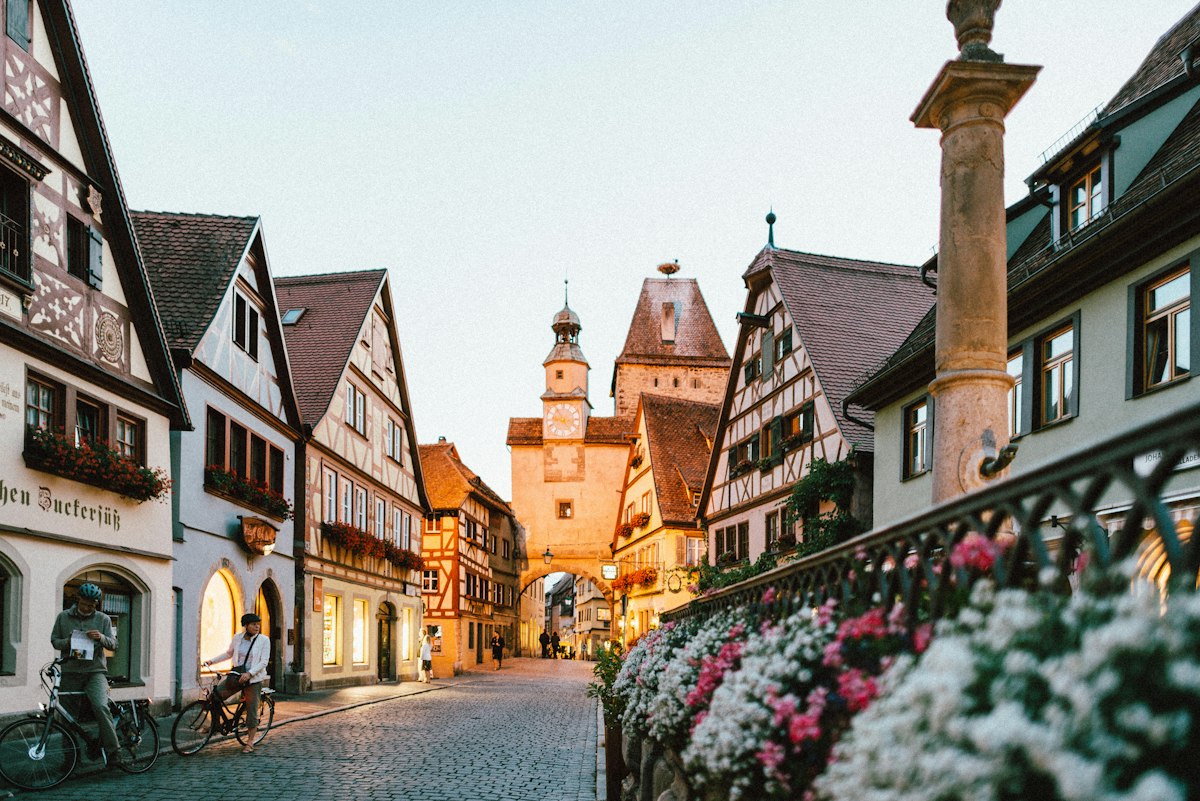
No place on the route is as famous as Rothenburg. The Plönlein – the small fork in the road with its half-timbered house, fountain and two towers – is one of the most photographed views in Germany. Almost more rewarding is the walkable town wall: on the covered sentry walk you can circle the old town in about an hour, looking out over rooftops and the Tauber valley. In the evening, the night watchman leads visitors through the lanes in historical costume; in season, the Night Watchman Tour starts daily on the market square and gives a vivid account of the town's harsh medieval everyday life. If Christmas traditions interest you, Käthe Wohlfahrt's German Christmas Museum is open all year round; at Whitsun, the town re-enacts its rescue in the Thirty Years' War with the "Meistertrunk" festival play.
Stayhaus tip: Stay overnight in Rothenburg instead of stopping for just two hours. Between 10am and 4pm, tour groups push through the lanes – in the early morning and after 5pm, the town belongs to its overnight guests.
Dinkelsbühl: the quieter sister
Just over half an hour to the south lies Dinkelsbühl, which need not fear comparison with Rothenburg: the completely preserved town wall with its towers, the Gothic minster of St George and the gabled houses on the Weinmarkt form a coherent old-town ensemble that came through the Second World War undamaged. Because far fewer coaches stop here, the town feels more everyday and calmer. Visitors in July experience the Kinderzeche, one of the oldest traditional festivals in southern Germany.
Nördlingen: the town in the crater
Nördlingen is the only town in Germany with a completely walkable, circular town wall – the circuit along the sentry walk takes about an hour. From the "Daniel", the 90-metre tower of St George's Church, you look out over the circular old town and the Nördlinger Ries: a meteorite crater formed around 14.5 million years ago. Many of the town's buildings are made of suevite, the rock created by the impact. The RiesKraterMuseum explains the geology so clearly that even NASA once trained its Apollo astronauts here.
Augsburg: the Fuggerei and the water system
With more than 2,000 years of history – founded in 15 BC as Roman Augusta Vindelicum – Augsburg is the big city of the route. Its most famous sight is the Fuggerei, the world's oldest social housing estate still in use, endowed by Jakob Fugger in 1521: the annual basic rent is still 0.88 euros, and residents commit to three prayers a day. Also worth seeing are the Golden Hall in the town hall and the historic water management system with its canals and water towers, added to the UNESCO World Heritage list in 2019.
Wieskirche: rococo in the meadows
Shortly before the edge of the Alps, in the middle of the Pfaffenwinkel, stands the Pilgrimage Church of the Scourged Saviour on the Wies, known simply as the Wieskirche. Plain on the outside, Dominikus Zimmermann's building unfolds inside into one of the most accomplished rococo interiors in Europe – a UNESCO World Heritage Site since 1983. The contrast between the open meadow setting near Steingaden and the light-flooded interior is what gives the place its particular appeal; most visitors allow 45 to 60 minutes here.
Füssen and Neuschwanstein Castle
The southern end point holds the best-known item on the programme: Neuschwanstein Castle near Schwangau, built for King Ludwig II from 1869 and opened to visitors as early as 1886, a few weeks after his death. Visits are only possible with a guided tour and a timed-entry ticket. Füssen itself is often underrated: the Hohes Schloss above the old town, the Lechfall waterfall on the edge of town and the baroque monastery of St Mang are worth half a day. The classic view of Neuschwanstein is from the Marienbrücke bridge above the Pöllat Gorge – though at busy times you will have to queue there. Right next door, Hohenschwangau Castle, where Ludwig II grew up, and the Museum of the Bavarian Kings on the Alpsee are also worth a visit – both far less crowded than their famous neighbour.
Stayhaus tip: Book your timed-entry ticket for Neuschwanstein online several weeks in advance through the official Hohenschwangau ticket centre. In high season, same-day tickets are the exception, not the rule.

Car, Europabus or train?
The Romantic Road was conceived as a driving route, but it is not limited to one. Three approaches have proven themselves.
By car
A car remains the most flexible choice: it is the only easy way to reach stops such as the Herrgottskirche in Creglingen or Harburg Castle. The route mostly follows federal roads, above all the B25 between Rothenburg and Donauwörth. Expect a leisurely pace – driving through the towns is part of the concept. In the old towns, park at the signposted car parks outside the walls; in Rothenburg, for example, at car parks P1 to P5. There are no tolls on German federal roads, and the route can of course also be driven from south to north – in autumn this has the advantage that you leave the Alpine panorama behind you and drive into the grape harvest.
By Europabus
For travellers without a car, the Romantic Road long-distance coach, often called the Europabus, runs in the summer season – generally from April to October. It covers the route between Frankfurt or Würzburg and Munich/Füssen once a day in each direction and stops at the main towns, including Rothenburg, Dinkelsbühl, Nördlingen and Augsburg. If you stay overnight along the way, you simply board again the next day. Reserve seats in advance; the Romantic Road tourism association publishes the current operating days before each season.
By regional train
The rail option works surprisingly well, especially with the Deutschlandticket. Würzburg and Augsburg are ICE stops, Rothenburg is reached with one change in Steinach (bei Rothenburg), Nördlingen is connected via Donauwörth or Aalen, and a regional line runs to Füssen from Augsburg via Buchloe. Gaps remain at Dinkelsbühl, which no longer has a passenger station, and at the Wieskirche – both are reached by regional bus, the Wieskirche from Füssen. If you only want the highlights, the best approach is to combine trains with the occasional bus day. Ideally, check timetables the evening before – on the branch lines, some services run only once an hour.
The stages at a glance
With all its loops and town crossings, the signposted route is around 460 kilometres long. The table shows the approximate distances between the main towns and one worthwhile stop along each stretch.
| Section | Distance (approx.) | Worth a stop |
|---|---|---|
| Würzburg – Rothenburg ob der Tauber | 100 km | Weikersheim Palace, Herrgottskirche in Creglingen (Riemenschneider altar) |
| Rothenburg – Dinkelsbühl | 50 km | Feuchtwangen with its Romanesque cloister |
| Dinkelsbühl – Nördlingen | 32 km | Wallerstein on the rim of the Ries |
| Nördlingen – Augsburg | 75 km | Harburg Castle above the Wörnitz, Donauwörth |
| Augsburg – Wieskirche | 95 km | Landsberg am Lech, Rottenbuch Abbey |
| Wieskirche – Füssen | 25 km | Schwangau with Hohenschwangau Castle |
The best time to travel
The most pleasant months are May and June, and September and October: mild weather, long days and far fewer crowds than in midsummer. Autumn has an extra argument in the Tauber valley with the grape harvest and the changing colours of the slopes. In May and June, the Würzburg Mozart Festival, with concerts in the Residence, enriches the start of the route. In August, Rothenburg and Neuschwanstein are heavily visited around midday – schedule sightseeing for the early morning or late afternoon and do your driving in the middle of the day.
December deserves a recommendation of its own: the Rothenburg Reiterlesmarkt turns the market square into one of the most atmospheric Christmas markets in southern Germany, and in winter light the town seems to belong to another era. In winter, however, note the reduced opening hours of smaller museums; the Marienbrücke at Neuschwanstein may be closed in icy conditions.
Where to stay along the route
The end points and Augsburg have proven themselves as bases. In the north, besides Würzburg, Nuremberg is a good option – the Franconian metropolis is only just over an hour from Rothenburg, has a wide choice of hotels and is worth an evening in itself. In the middle of the route, Augsburg with its rail connections is the logical stop. At the southern end, many travellers stay in Füssen or continue to Munich, reached by regional train in around two hours. Budget-conscious visitors will find options among the affordable hotels in Munich even in high season; our hotel overview lists all properties along the route. If you drive the route the other way, simply reverse the logic: Munich and the castles first, Franconian wine in Würzburg to finish. Book Rothenburg and Füssen as early as possible in high season – the choice within the small old towns is limited.
Practical information
- Length: around 460 km from Würzburg to Füssen; recommended duration 3–5 days by car.
- Getting there: ICE stops in Würzburg, Augsburg and Munich; Füssen by regional train from Augsburg/Munich.
- Signposting: brown "Romantische Straße" signs in both directions; parallel cycle path and hiking trail (each approx. 500 km).
- Neuschwanstein: visits only with a guided tour and timed-entry ticket; book online several weeks ahead, admission approx. 15–25 €.
- Würzburg Residence: admission approx. 10–12 €; the court garden is free to enter.
- Europabus: generally runs April–October, once daily in each direction; reservation recommended.
- Local transport: regional trains and buses are covered by the Deutschlandticket – the cheapest option for individual stages.
- Best time to travel: May–June and September–October; December for the Reiterlesmarkt in Rothenburg.