Berlin covers almost nine times the area of Paris, and its sights are spread across several districts, each telling its own story. First-time visitors therefore need one thing above all: a plan that saves unnecessary journeys. Three days are enough for a solid first impression – provided you dedicate each day to one coherent part of the city instead of criss-crossing the S-Bahn and U-Bahn network.
That is exactly how this guide is structured. Day one belongs to the historic centre between the Brandenburg Gate and Museum Island, day two to the former border districts of Kreuzberg and Friedrichshain, day three to the bourgeois west around Charlottenburg Palace – or, alternatively, to a day trip to Potsdam. Added to that are a district comparison table for choosing your hotel, the essentials of public transport and practical information on getting there. You will find an overview of the destination with all accommodation on our Berlin page.
Day 1: The Historic Centre – from the Brandenburg Gate to Museum Island
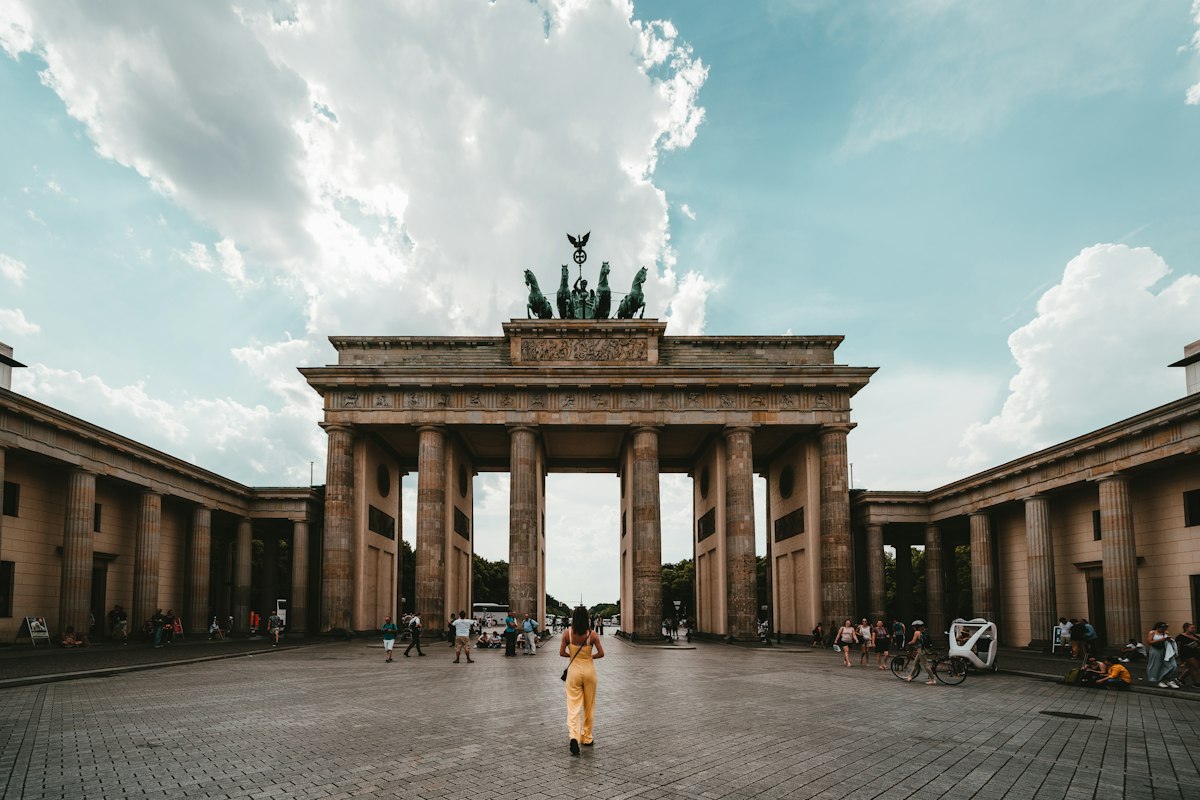
Start early at the Brandenburg Gate, Berlin's only surviving city gate and, since 1791, the backdrop to almost every turning point in German history. Before nine in the morning you will have Pariser Platz almost to yourself; the Brandenburger Tor S-Bahn station (S1, S2, S25) lies directly beneath it. A few steps to the south stretches the Memorial to the Murdered Jews of Europe with its 2,711 concrete stelae – allow half an hour to walk through the field of stelae and visit the underground information centre.
The Reichstag: Dome Visits by Registration Only
Just around the corner stands the Reichstag building, seat of the German Bundestag. Norman Foster's walkable glass dome is free to visit, but only with prior registration through the Bundestag visitor service – ideally reserve online a few days in advance, with ID details for everyone in your party. The free audio guide starts automatically as you climb the spiral ramp and explains the panorama from the Tiergarten to the TV Tower.
Stayhaus tip: Book your dome slot for the early evening. In clear weather you will watch the sun set over the Tiergarten while the city lights up beneath you. If you decide at short notice, ask at the service point next to the Berlin-Pavillon on Scheidemannstrasse about remaining slots for the next two hours.
Unter den Linden and Gendarmenmarkt
From Pariser Platz, the boulevard Unter den Linden leads east past the State Opera, Humboldt University and the Neue Wache, the central memorial to the victims of war and tyranny. On Bebelplatz, an underground library with empty shelves commemorates the book burning of 1933. A short detour to the south is worthwhile: Gendarmenmarkt, with the Konzerthaus and the German and French cathedrals, is considered the city's finest neoclassical ensemble and a good spot for a coffee break.
Museum Island and Berlin Cathedral
In the afternoon you reach Museum Island, a UNESCO World Heritage Site since 1999. Five museums stand here in close proximity; for one afternoon you should concentrate on one or two. The first choice is the Neues Museum with the bust of Nefertiti and the Egyptian collection, followed by the Alte Nationalgalerie with nineteenth-century painting from Caspar David Friedrich to Adolph Menzel. The Pergamonmuseum is closed for years of comprehensive renovation; the Panorama am Kupfergraben offers a substitute, reconstructing the view of ancient Pergamon. Admission is around 12–16 € per museum, and timed tickets are best booked online. Entering via the James Simon Gallery helps you avoid the queues.

Right on the Lustgarten rises Berlin Cathedral, whose dome walkway rewards you after 270 steps with one of the best views over the Spree and Museum Island. The best place to end the evening is around Hackescher Markt: the winding Hackesche Höfe courtyards and the Scheunenviertel are lined with restaurants, wine bars and small shops. If your feet are tired, board one of the excursion boats by the cathedral or in the Nikolaiviertel instead: a one-hour Spree cruise through the government quarter costs around 20–25 € and shows you the Reichstag, Hauptbahnhof and Museum Island once more from an entirely different perspective.
Day 2: Kreuzberg and Friedrichshain – Wall, Market Hall, Airfield
The second day shows the other Berlin: rougher, younger, shaped by immigration and by three decades of division. The two districts face each other directly across the Spree and are easy to combine on foot and with the U1.
East Side Gallery and Oberbaumbrücke
Start at Ostbahnhof and walk along Mühlenstrasse: at 1.3 kilometres, the East Side Gallery is the longest surviving section of the Berlin Wall, painted in 1990 by more than a hundred artists – including Dmitri Vrubel's famous fraternal kiss between Brezhnev and Honecker. The visit is free and possible at any time. At the southern end, the Oberbaumbrücke with its neo-Gothic brick towers spans the Spree; the U1 rattles across the viaduct above, while below you cross from Friedrichshain into Kreuzberg. If you want to dig deeper into the history of the division, add the Berlin Wall Memorial on Bernauer Strasse to your plan (S-Bahn Nordbahnhof): a death strip, a watchtower and the inner wall survive there in their original state, and the documentation centre puts the images into context – admission is free.
Markthalle Neun and Turkish Cuisine
Ten minutes further on lies Markthalle Neun on Eisenbahnstrasse, a restored brick market hall from 1891 with a bakery, a butcher and regional stalls. On Thursdays from 5 pm, Street Food Thursday turns the hall into one of the best addresses in town for an early dinner. If you prefer to eat at lunchtime, stick to the Turkish cuisine around Kottbusser Tor: the snack bars on Adalbertstrasse serve vegetable kebabs and lahmacun, and on Tuesdays and Fridays the weekly market with its Turkish stalls spreads out along the Landwehr Canal at Maybachufer. A classic for in between remains the Currywurst – the best-known address is Curry 36 on Mehringdamm.
Tempelhofer Feld
Spend the afternoon on Tempelhofer Feld. The airport, decommissioned in 2008, is now one of Europe's largest inner-city open spaces at over 300 hectares: people cycle, jog and fly kites on the old runways, with community gardens and barbecue lawns in between. Entrances include Columbiadamm, Tempelhofer Damm and Oderstrasse; the nearest underground stations are Platz der Luftbrücke and Paradestrasse (U6). Towards evening it is worth heading back to Friedrichshain: around Boxhagener Platz and Simon-Dach-Strasse you will find pubs and restaurants in every price range.
Day 3: Charlottenburg – or a Day Trip to Potsdam
For the third day there are two equally good programmes. Option A stays in the city and is devoted to the old West; option B heads out to the Prussian residence town of Potsdam.
Option A: Charlottenburg Palace, Ku'damm and KaDeWe
Charlottenburg Palace is Berlin's largest surviving Hohenzollern residence, begun in 1699 as a summer retreat for Queen Sophie Charlotte. The highlights are the baroque Old Palace with its porcelain cabinet and the New Wing with the private apartments of Frederick the Great; admission is around 12–19 € depending on the combination, while the extensive palace garden on the Spree is free. You can reach the palace with the U2 to Sophie-Charlotte-Platz plus a ten-minute walk, or by bus M45. Afterwards, head for the Kurfürstendamm: the 3.5-kilometre boulevard was West Berlin's shop window, and at its eastern end the tower ruin of the Kaiser Wilhelm Memorial Church stands as a reminder of the war. At Wittenbergplatz (U1, U2, U3) the KaDeWe is worth a visit – continental Europe's largest department store, whose gourmet floor on level six is an attraction in itself. For dinner, the streets around Savignyplatz are your best bet.
Option B: Potsdam and Sanssouci Park
The RE1 regional express takes you to Potsdam from Hauptbahnhof or Friedrichstrasse in around 25 minutes, or take the S7 in about 40 minutes; you will need a ticket for fare zone ABC. The main destination is Sanssouci Park with Frederick the Great's vineyard palace of 1747: the interiors are visited with a timed ticket (around 12–20 €, reserve online), while the park itself is open for a voluntary donation. Afterwards, allow an hour for the Dutch Quarter with its red-brick houses before returning to Berlin.
Where to Stay? The Districts Compared
Your choice of district shapes the character of your trip more than any individual hotel. Here are the four most popular options for first-time visitors at a glance:
| District | Character | Good for | Price per night (double room) |
|---|---|---|---|
| Mitte | Central, sights within walking distance, quiet in parts at night | First-time visitors, short distances | approx. 120–220 € |
| Kreuzberg | Lively, multicultural, plenty of bars and restaurants | Nightlife, street food | approx. 90–160 € |
| Charlottenburg | Bourgeois, refined, classic West Berlin | Comfort, shopping, quiet nights | approx. 100–180 € |
| Friedrichshain | Young, unfussy, close to clubs and the Spree | Small budgets, local scene | approx. 80–140 € |
The prices are a guide for the low season; during trade fairs such as ITB and around the Berlin Marathon at the end of September they rise considerably. In Berlin, early bookers almost always get the better deal.
Getting Around: S-Bahn, U-Bahn and the Day Ticket
Berlin has one of the densest public transport networks in Europe, and for visitors the maths is simple: fare zone AB covers the entire city, the AB day ticket costs around 10–12 € and pays off from the third journey onwards. Single tickets cost around 3–4 €. For orientation, two axes are all you need at first: on the east–west Stadtbahn line, the S5 and S7 connect Zoologischer Garten, Hauptbahnhof, Friedrichstrasse, Hackescher Markt, Alexanderplatz, Ostbahnhof and Warschauer Strasse – practically every destination of days one and two. The U2 links Charlottenburg with Alexanderplatz via Zoologischer Garten and Potsdamer Platz. At weekends the S-Bahn and U-Bahn run all night; on weekdays night buses take over. Remember to validate paper tickets before boarding; if you use a mobile ticket, you can skip the machines altogether.
Stayhaus tip: Before your trip, compare the Berlin Welcome Card with the plain day ticket. The Welcome Card combines public transport with discounts on many museums and tours – but it only pays off if you actually use at least two of the partner offers per day.
Staying Overnight in Berlin
The spectrum ranges from grand hotels on Pariser Platz to hostel beds in Friedrichshain, with one of Europe's largest hotel landscapes in between – at comparatively moderate prices. If you are looking for classic luxury, you will find the right addresses around Gendarmenmarkt, Unter den Linden and the Ku'damm – our overview of 5-star hotels in Berlin shows a selection. Price-conscious travellers will find the best value above all in Friedrichshain, Kreuzberg and on the border with Neukölln; our page listing budget hotels in Berlin is well stocked for exactly that. All bookable hotels across Germany are listed in our hotel overview.
Practical Information
Getting There by Train and Plane
By rail, you reach Berlin Hauptbahnhof by ICE from Hamburg in around 1 hour 45 minutes, from Frankfurt am Main in about 4 hours and from Munich in a good 4 hours; the station is central, and the S5 and S7 take you straight on to your hotel. Flights land at Berlin Brandenburg Airport (BER) in the south-east of the city. The FEX airport express reaches Hauptbahnhof in around 30 minutes, supplemented by the S9 and S45 and regional trains; BER lies in fare zone C, so you need an ABC ticket into the city centre.
Public Transport
Within the city, the AB day ticket is all you need; trams, buses and the BVG ferries are included. Only for Potsdam and the airport do you need zone C. Rental bikes and e-scooters are available on almost every corner, and routes such as Tempelhofer Feld or the Tiergarten are at their best explored by bike. One restriction applies: cycling on pavements is prohibited, so stay on the marked lanes. If you would rather be driven, the usual ride-hailing apps operate alongside the taxis – often the most relaxed option at night.
Best Time to Visit
The most reliable months for a city break are May to September, when the beer gardens and the banks of the Spree are in full swing and it stays light until after 9 pm. December scores with its Christmas markets, above all on Gendarmenmarkt. January and February are grey and cold, but hotel prices are then at their lowest and the museums pleasantly empty – not a bad choice for a culture-heavy itinerary.