When the first stalls open at the end of November, the busiest travel season of the winter begins in Germany's city centres. Almost every town has a Christmas market – but a handful stand out so clearly for their history, setting and specialities that they justify a city break in their own right. Nuremberg's Christkindlesmarkt and Dresden's Striezelmarkt have been competing for decades over the title of the country's most famous market; Cologne, Stuttgart and Munich have found their own, very different answers to the question of what an Advent visit should look like.
This guide presents the five most rewarding destinations – with what actually sets each market apart, a comparison table with approximate dates and practical advice: from which days are best for browsing to booking your hotel in good time, which in Advent makes all the difference to the cost of the trip. All five destinations work as a weekend trip by train – and, if you like, can even be combined into a winter city tour.
Nuremberg Christkindlesmarkt: the classic
No German Christmas market is better known internationally. The Christkindlesmarkt on the Hauptmarkt traditionally opens on the Friday before the first Sunday of Advent, when the Nuremberg Christkind – a young woman from the city elected for a two-year term – recites the ceremonial prologue from the balcony of the Frauenkirche. Below, around 180 stalls with red-and-white canopies crowd the square, and their range is strictly regulated: you will look in vain for plastic garlands or piped music. Right next door, two smaller markets extend the offering: the Market of the Sister Cities, where Nuremberg's international partner towns from Glasgow to Shenzhen run their own stalls, and the Children's Christmas on Hans-Sachs-Platz with its historic carousel. Also worth catching is the Männleinlaufen: every day at noon, the prince-elector figures on the Frauenkirche clock circle Emperor Charles IV.
What to try
On the food side, two classics are unavoidable: Elisenlebkuchen, gingerbread whose dough contains hardly any flour but plenty of nuts, and the Original Nuremberg Rostbratwürste, sold at the market as "Drei im Weggla" – three small sausages in a bread roll. The traditional souvenir is the Zwetschgenmännle: little figures made of dried plums and figs, produced in Nuremberg since the 18th century. To escape the bustle for a moment, walk up to the Kaiserburg in ten minutes – the view over the winding rooftops of the old town is one of the best moments of a Nuremberg visit in Advent. Elisenlebkuchen, by the way, are best bought directly from one of the city's long-established gingerbread bakeries – freshly packed, they survive the journey home without difficulty and keep well into the new year.

Dresden Striezelmarkt: the oldest
Dresden holds the record: the Striezelmarkt on the Altmarkt has been documented since 1434, making it Germany's oldest recorded Christmas market. Its name derives from the "Strüzel", the forerunner of the Dresden Christstollen, which remains the heart of the market to this day. Among the stalls stands the world's tallest Erzgebirge step pyramid at a good 14 metres; candle arches, Herrnhut stars and wooden folk art from the Ore Mountains shape the scene more strongly than at any other big-city market. Around 230 stalls spread across the square; among them turns a historic Ferris wheel, and children have their own fairy-tale house with a daily programme.
Stollen festival and Pflaumentoffel
The highlight is the Stollenfest on the Saturday before the second Sunday of Advent: a giant Stollen weighing several tonnes is carried in procession through the old town to the market, where it is cut with an oversized knife and sold. Another Dresden speciality is the Pflaumentoffel, a little chimney sweep made of baked plums, given as a good-luck charm. A market visit combines well with the Frauenkirche, the Zwinger and an evening walk along the Brühl Terrace. If the Altmarkt gets too crowded, head for the Stallhof of the Royal Palace: a medieval-style market opens there with craft demonstrations and mead heated over the fire – one of the most atmospheric side venues of Advent in Dresden. Musically, the Christmas vespers of the Kreuzchor choir in the Kreuzkirche traditionally close the season.
Cologne's Christmas markets: the variety
Cologne relies not on one market but on half a dozen, all within walking distance of each other. The most striking picture is provided by the market at the cathedral: beneath the illuminated twin-tower facade, the stalls surround a large stage with a daily music programme – hardly any other German market has a comparable backdrop.
From the cathedral to the harbour
A few minutes to the south, the harbour Christmas market at the Chocolate Museum is worth a visit: maritime in style, with views of the Rhine and noticeably more relaxed than the city-centre markets. In between lie the Heinzelmännchen market in the old town between Alter Markt and Heumarkt and the "Market of Angels" on Neumarkt. On the food front, Reibekuchen potato fritters with apple sauce and a Feuerzangenbowle are part of the Cologne Advent programme; in between, you can warm up in a brewery tavern over a glass of Kölsch. Incidentally, the old-town market takes its name from the Cologne legend of the Heinzelmännchen, the nocturnal helpers who once did the citizens' work for them – on the market, their figures reappear on many of the stalls. If you want to browse in peace, come right at opening in the late morning: from early evening onwards, the market at the cathedral is among the busiest in the country.
Stuttgart Christmas Market: the decorated rooftops
Stuttgart runs one of the largest Christmas markets in Europe – first mentioned in 1692 – and has a peculiarity you only come to appreciate at second glance: every year, the nearly 300 stallholders compete for the most elaborately decorated stall roof. The results range from complete winter landscapes to life-size figures and moving scenes; a stroll with your eyes turned upwards should be firmly on the agenda. The market stretches from Schlossplatz across Schillerplatz to the Marktplatz, joined by an antiques market and a Finnish Christmas village.

Swabian specialities set the offering apart from its Franconian and Saxon rivals: alongside roasted almonds you will find Hutzelbrot fruit bread, Maultaschen and Schupfnudeln served straight from the stall. Against the historic backdrop of the Old Palace and the collegiate church, the market feels remarkably orderly despite its size. On Advent evenings, free concerts are held in the arcaded courtyard of the Old Palace. And if you can add a day, take the S-Bahn to nearby Esslingen am Neckar, whose medieval market with jugglers and historical crafts has a following of its own.
Munich Christkindlmarkt: Advent on Marienplatz
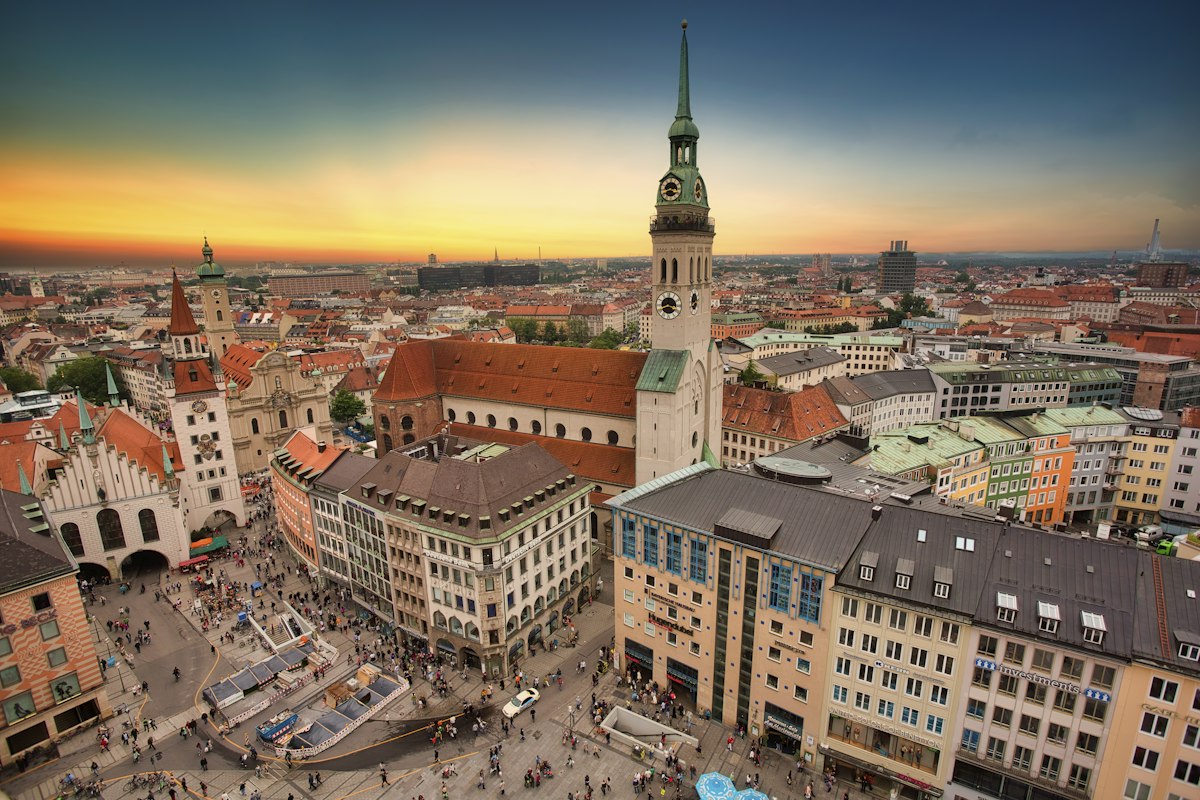
Munich's Christkindlmarkt fills Marienplatz directly in front of the neo-Gothic New Town Hall, whose illuminated facade, together with the great Christmas tree, defines the scene. On weekdays at 5.30pm, Advent music sounds from the town hall balcony – a short, understated fixture that suits the city well. Also worth seeing is the adjoining Kripperlmarkt, one of Germany's largest nativity markets, selling figures, stables and accessories at every price level. The market's roots reach back to the 14th century – it has been documented as a St Nicholas market since 1310 – and it has stood at its current location on Marienplatz since 1972.
The Krampus run provides a counterpoint: on several Advent Sundays, around 300 figures in carved masks and fur costumes move across the market in the Alpine tradition – loud, wild and not for very small children, but a spectacle found in this form at no other major German city market. If you have more time, Munich also offers dozens of neighbourhood markets, from Sendling to Haidhausen. An alternative with a different character is the Tollwood winter festival on Theresienwiese: crafts, international food and a cultural programme in heated tents, open until after New Year's Eve. If you need to stretch your legs after the market, there is an open-air ice rink on Karlsplatz.
Dates, comparison and tips
The exact dates are only fixed each year in the summer; as a rule of thumb, the big markets open at the end of November and close on 23 or 24 December. If you want to combine several markets: Nuremberg and Munich are a good hour apart by train, and Stuttgart can be reached from Munich in a good two hours; Dresden and Cologne, on the other hand, require trips of their own. The table summarises the key facts.
| City | Period (approx.) | Typical speciality | Destination |
|---|---|---|---|
| Nuremberg | Late November – 24 December | Elisenlebkuchen, "Drei im Weggla" | Hotels in Nuremberg |
| Dresden | Late November – 24 December | Dresden Christstollen, Pflaumentoffel | Hotels in Dresden |
| Cologne | Late November – 23 December | Reibekuchen, Feuerzangenbowle | Hotels in Cologne |
| Stuttgart | Late November – 23 December | Hutzelbrot, Maultaschen | Hotels in Stuttgart |
| Munich | Late November – 24 December | Roasted almonds, nativity figures | Hotels in Munich |
Picking the right time
The Advent weekends are crowded at all five markets – in Nuremberg and Cologne sometimes so crowded that little browsing is possible. Tuesday to Thursday is far more relaxed, ideally in the late afternoon: the lights are already on, but the after-work rush has not yet arrived. If weekends are your only option, go in the morning and save museums or churches for the busy afternoon hours.
Mulled wine and the deposit system
At practically every stall you pay a deposit of around 2–5 € on the mug. The collectable mugs with city motifs, which change every year, are yours to keep – in which case you simply forfeit the deposit – or you can return them to the stall. Alongside the standard offering you will find regional variations such as Nuremberg's blueberry mulled wine or white mulled wine; alcohol-free punch is now on the menu everywhere. Also expect to pay cash at smaller stalls; not every stand accepts cards.
Getting there and what to wear
All five cities are easily reached by long-distance train; each market is only a few minutes from the main station on foot or by local transport. Avoid driving in Advent if you can – city-centre car parks fill up regularly at weekends. And do not underestimate the cold: a market stroll quickly turns into two or three hours on your feet, and lined shoes and gloves make more of a difference than any second mug of mulled wine. The most atmospheric hour begins everywhere at dusk around half past four, when the lights take over and the church towers remain as silhouettes.
Stayhaus tip: Book your Advent hotel by October at the latest. In Nuremberg and Dresden, central properties are often fully booked months ahead for the Advent weekends, and prices rise sharply towards December – early bookers sometimes pay half as much.
Where to stay in the Christmas cities
Short distances count double in Advent: staying centrally means you can wander the market in the evening without a train ride and be there before the day visitors in the morning. In Nuremberg, look for somewhere within the old town ring; in Dresden, the inner old town and Neustadt; in Cologne, the area around the cathedral and old town. For Stuttgart, the city centre around Schlossplatz is the best choice, and in Munich anything within reach of Marienplatz and the main station. For a full overview with price and location filters, see our hotel overview. On price, it pays to look at the days of the week: Sunday-to-Monday or midweek stays in Advent are often considerably cheaper than the classic Friday and Saturday nights.
Practical information
- Season: the big markets open around the Friday before the first Sunday of Advent and close on 23 or 24 December, usually in the early afternoon of the final day.
- Opening hours: generally daily from around 10am to 9pm; the cities publish exact times in the autumn.
- Admission: all five markets presented here are free to enter.
- Budget: mulled wine approx. 4–6 € plus a deposit of approx. 2–5 €; snacks at the stalls approx. 5–12 €.
- Getting there: all five cities have main stations close to the markets; in Advent the train beats the car, as city-centre car parks fill up at weekends.
- Best time to visit: Tuesday to Thursday in the late afternoon; avoid Advent weekends if possible.
- With children: Nuremberg (Children's Christmas), Dresden (fairy-tale house) and Stuttgart offer dedicated children's areas with carousels and hands-on activities.
- Hotel booking: by October at the latest; weekend dates in Nuremberg and Dresden even earlier.