Munich asks its visitors to make a choice that hardly any other big German city demands: between world-class museums and a beer garden bench, between a densely built old town and a city park larger than Central Park. The good news is that distances are short. Almost everything worth seeing lies within the Mittlerer Ring, and anything beyond it – above all Neuschwanstein Castle in the Allgäu – is easily reached by regional train.
This guide takes you through the old town between Marienplatz and the Viktualienmarkt, into the Pinakothek museums of the Kunstareal, to the Eisbach wave in the English Garden and to the city's four most important beer gardens. Added to that are an overview of the best districts to stay in and all the practical information on getting there. You will find a full overview of the destination with all bookable accommodation on our Munich page.
The Old Town: Marienplatz, Viktualienmarkt and Two Remarkable Churches
Marienplatz and the Glockenspiel
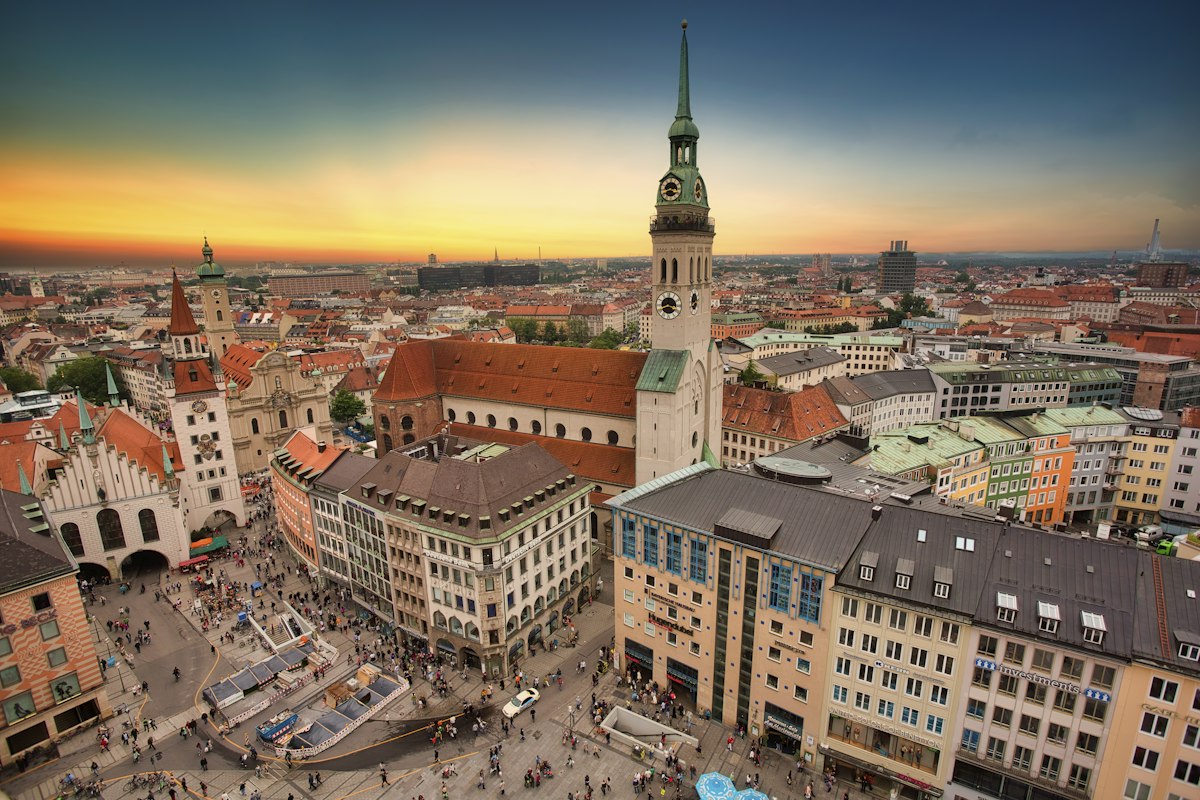
The centre of the city has been Marienplatz since the Middle Ages, dominated by the New Town Hall with its neo-Gothic facade. Every day at 11 am and 12 noon – and additionally at 5 pm from March to October – the Glockenspiel in the town hall tower springs into action: 32 figures re-enact the knights' wedding of 1568 and the coopers' dance. If you want to see the square from above, take the lift up the town hall tower or climb the 306 steps of the Alter Peter, the tower of St Peter's Church next door; on a clear föhn day the view stretches all the way to the Alps.
Viktualienmarkt
Two minutes' walk to the south begins the Viktualienmarkt, the city's central food market since 1807. Around 100 stalls sell Bavarian cheese, smoked fish, fruit, flowers and spices – and in the middle there is a beer garden under chestnut trees where Munich's six great breweries take turns to pour. The market is open from Monday to Saturday; on Sundays the stalls stay closed. For a quick lunch, the soup kitchen and the fish grills on the edge of the market are a reliable choice.
Frauenkirche and Asamkirche
The late-Gothic Frauenkirche with its two 99-metre towers and characteristic onion domes is the city's landmark – no building in the city centre may be built higher. Inside, look out for the so-called devil's footprint at the entrance and the tomb of Emperor Louis the Bavarian; the south tower can be reached by lift. The Asamkirche on Sendlinger Strasse is a different world altogether: the Asam brothers built it in the eighteenth century as a private foundation, and on barely 30 metres of length the full exuberance of Bavarian late baroque unfolds. Admission is free and a visit rarely takes longer than a quarter of an hour – which is exactly why it belongs on your itinerary.
Between the two churches lies the Residenz, the former city palace of the Wittelsbach dynasty and today one of Europe's largest museums of palace interiors. The highlights are the Antiquarium – a 66-metre Renaissance hall –, the treasury with the crown insignia and the rococo gem of the Cuvilliés Theatre; admission is around 10–17 € depending on the combined ticket. Directly behind it opens the Hofgarten with its arcades, and on Odeonsplatz the Feldherrnhalle quotes the Loggia dei Lanzi in Florence – a good spot to end your old town walk.
Museums: The Kunstareal and the Deutsches Museum
The Pinakothek Museums
In the Maxvorstadt, the three Pinakothek museums stand only a few steps apart. The Alte Pinakothek shows European painting from the fourteenth to the eighteenth century, including Dürer's self-portrait in a fur coat and Rubens' monumental group of works. The Neue Pinakothek, home to the art of the nineteenth century, is closed long-term for complete renovation; in the meantime its most important works – among them van Gogh's Sunflowers – hang on the ground floor of the Alte Pinakothek. The Pinakothek der Moderne unites four collections of art, graphics, architecture and design under one roof. Regular admission is around 7–10 € per museum.
Stayhaus tip: Plan your museum visits for a Sunday. On that day the Alte Pinakothek, the Pinakothek der Moderne and other state museums such as the Museum Brandhorst charge only a symbolic one euro admission. Arrive when the doors open at 10 am and you will have the galleries largely to yourself.
Deutsches Museum
On the Museumsinsel in the Isar stands the Deutsches Museum, one of the largest science and technology museums in the world. Following its modernisation, the departments – from aerospace to musical instruments to the famous mine exhibit – are presented in fresh condition; admission is around 15–18 €. Realistically the museum is half a day's programme, so pick three or four departments in advance rather than trying to cover all 20 kilometres of exhibition space.
The English Garden: Eisbach Wave, Monopteros and Beer Culture
The Eisbach Wave
At the southern edge of the English Garden, directly behind the Haus der Kunst, surfers ride the Eisbach wave all year round – a standing wave in the ice-cold city stream that has long been one of the most photographed spots in Munich. Only experienced surfers ride here – the wave is no place for beginners – but watching from the bridge on Prinzregentenstrasse costs nothing and is worth it in any season. From there the path leads into a park that, at 375 hectares, ranks among the largest inner-city green spaces in the world: past the Monopteros with its view of the old town skyline, on to the Chinese Tower and further to the Kleinhesseloher See.
Beer Garden Culture: The Key Addresses Compared
The beer garden is a Munich institution with rules of its own: in the self-service areas you may bring your own picnic, only the drinks must come from the taps. A Mass of beer costs around 9–13 € depending on the house. In good weather the gardens are generally open from spring until well into October, usually until 11 pm; the big houses have no fixed closing day. The four most important addresses at a glance:
| Beer garden | Seats | Location | Atmosphere |
|---|---|---|---|
| Chinesischer Turm | approx. 7,000 | English Garden | Lively and international, brass band playing from the tower, plenty of cyclists and students |
| Augustiner-Keller | approx. 5,000 | Arnulfstrasse, near the main station | Traditional house under old chestnut trees, beer from the wooden barrel, plenty of locals |
| Königlicher Hirschgarten | approx. 8,000 | Nymphenburg | The largest beer garden in the city, family-friendly, with a deer enclosure next door |
| Seehaus | approx. 2,500 | Kleinhesseloher See | Polished and slightly more upmarket, right on the water, lovely in the evening |
As a rule of thumb: the Chinese Tower is the first choice for visitors in the middle of the park, the Augustiner-Keller the best address for the evening before departure, the Hirschgarten ideal for families and the Seehaus the right place when you want things a little quieter.
Eating Bavarian: Weisswurst, Brezn and Schweinsbraten
Munich's cuisine is hearty but precise. The Weisswurst is traditionally eaten only in the morning – classically with sweet mustard, a fresh Brezn and a wheat beer, and according to legend it must not hear the church bells strike noon. Good addresses for it are the taverns around the Viktualienmarkt. At lunch or in the evening, roast pork with crackling and dumplings, Obazda and Kaiserschmarrn belong on the menu. You are welcome to have a look at the world-famous Hofbräuhaus, but houses such as the Augustiner Bräustuben on Landsberger Strasse or the Wirtshaus in der Au, known for its dumpling variations, are more reliable culinary bets. In the well-known taverns an evening reservation is almost always necessary. In the afternoon, treat yourself to a slice of Prinzregententorte in one of the traditional city-centre cafés, for instance Café Luitpold on Brienner Strasse; and if you prefer market to tavern atmosphere, eat standing up at the Viktualienmarkt at lunchtime – hardly anywhere in the old town serves a warm meal for less.
Day Trip: Neuschwanstein Castle and Füssen
The most famous excursion from Munich leads to the Allgäu: Neuschwanstein Castle, built from 1869 for King Ludwig II, sits above Hohenschwangau against the backdrop of the Ammergau Alps. The regional train takes you from the main station to Füssen in around two hours; from there buses 73 and 78 reach the ticket centre in Hohenschwangau in about ten minutes. For train and bus the Bayern-Ticket is worth it: for a fixed price it is valid all day on regional transport and lets up to five people travel together. The walk up to the castle takes about 30 to 40 minutes; if you want to save your legs, take the shuttle bus or a horse-drawn carriage.

Stayhaus tip: Be sure to book the castle tour online in advance through the official Hohenschwangau ticket centre – in high season the daily on-site allocations are often gone by mid-morning. The classic view of the castle is from the Marienbrücke above the Pöllat Gorge; check before your trip that it is open, as it is closed in ice and snow.
After the tour, allow another hour for the old town of Füssen before the train back to Munich – the painted facades of the Reichenstrasse and the Hohes Schloss are worth the small detour. If you make an early start, combine the excursion with a loop around the Alpsee near Hohenschwangau: the lakeside path takes about an hour and a half and is one of the most rewarding easy walks in the region.
Staying Overnight in Munich: The Districts at a Glance
Old Town
Stay centrally and you have Marienplatz, the Viktualienmarkt and the Residenz on your doorstep – but you pay the highest prices in the city for it. This is also where the luxury houses are concentrated; our overview of 5-star hotels in Munich shows a selection.
Schwabing and Maxvorstadt
North of the old town lie the museums of the Kunstareal, the Ludwig Maximilian University and the English Garden. These districts are lively but not loud – a good choice for anyone who appreciates cafés and bookshops and wants green space within walking distance.
Haidhausen
East of the Isar, around the Ostbahnhof and the so-called French quarter, you stay in quieter and often cheaper surroundings. Even so, the S-Bahn and U-Bahn get you to Marienplatz in a few minutes, and the density of traditional taverns is high.
Around the Main Station
The station quarter is functional rather than pretty, but nowhere is the choice of affordable beds greater, and every train – including the one to Füssen – departs from your doorstep. You will find suitable houses in our overview of budget hotels in Munich; all bookable accommodation across Germany is listed in our hotel overview.
Practical Information
Getting There by Train and Plane
Munich Hauptbahnhof is an ICE hub: from Frankfurt am Main you arrive in a good 3 hours, from Berlin in around 4 hours, from Hamburg in about 5 hours 30 minutes. Munich Airport (MUC) lies around 35 kilometres north-east of the city in the Erdinger Moos; the S1 and S8 run alternately about every ten minutes into the city centre, and the journey to Marienplatz takes around 40 minutes. A Lufthansa express bus to the main station is the alternative if you are travelling with heavy luggage. Connections from abroad are good too: Railjet trains from Salzburg reach Munich in around 1 hour 30 minutes, and from Zurich the journey takes about 3 hours 30 minutes.
Public Transport
The MVV network of S-Bahn, U-Bahn, tram and bus covers the whole city; for visitors, zone M is almost always sufficient, and the day ticket for it costs around 9–10 €. All S-Bahn lines bundle together on the trunk route between Hauptbahnhof, Marienplatz and Ostbahnhof, and the U3 and U6 stop directly beneath Marienplatz. For the airport you need zones M to 5. The city centre itself is best explored on foot – it is two minutes from Marienplatz to the Frauenkirche and three to the Viktualienmarkt. Buy tickets at the machines or via app; paper tickets must be validated before boarding. For short hops, the MVG rental bikes at almost every major junction are a practical addition.
Best Time to Visit
From May to September, Munich is at its best, with the beer gardens open daily and the banks of the Isar buzzing. From late September to early October the Oktoberfest takes over the city – if you are not coming for the Wiesn, avoid this period, as hotel prices multiply. Advent has its own appeal with the Christkindlmarkt on Marienplatz, and in winter the Alps beckon on the doorstep; for the museums, in turn, the quiet months of January and February are ideal.