Cologne makes things easy for visitors: step out of the main station and a few paces later you are standing before the west facade of the cathedral – an opening no other major German city can match. The 2,000-year-old Roman city on the Rhine is no beauty in the classical sense; the rebuilding after 1945 was pragmatic rather than elegant. What Cologne has instead cannot be built: an everyday culture of brewhouses, neighbourhoods and Rhenish ease that draws visitors in faster than almost any other city in the country.
This guide takes you from the cathedral through the ritual of Kölsch to the quarters west of the centre – and straight through Germany's most famous municipal rivalry, with a day trip to Düsseldorf. You will find an overview of all accommodation on our Cologne page.
Cologne Cathedral: 632 years in the building
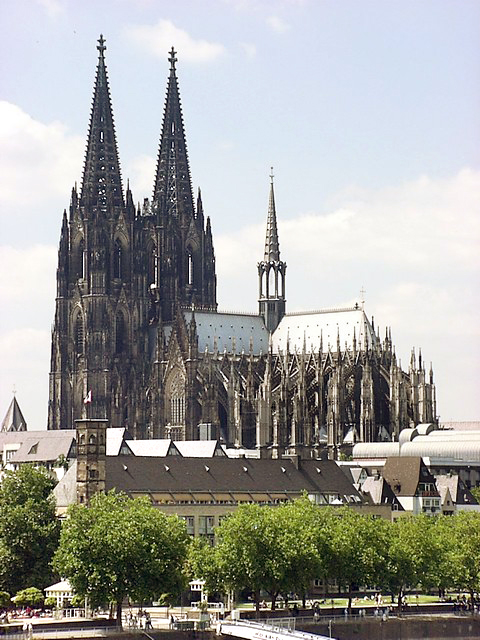
Begun in 1248, completed in 1880: few buildings carry as much European history as the cathedral church of St. Peter, a UNESCO World Heritage Site since 1996. At 157 metres, its towers briefly made it the tallest building in the world upon completion, and it still dominates every view of the city – not least because no new construction in the centre is allowed to rise above it. Entry to the nave is free; take time for the medieval stained glass and for the Richter window of 2007 in the south transept, whose 11,500 coloured squares read like digital noise.
That more than six centuries lay between the laying of the foundation stone and completion was above all a question of money: construction stalled in the late Middle Ages, and the wooden crane on the stump of the south tower defined the city's silhouette for some 400 years. Only the Romantic era's enthusiasm for the Middle Ages, backed by Prussian funds, brought the project to completion in the 19th century – following the original plans of 1280.
Climbing the tower
Some 533 steps wind up a narrow spiral staircase to the viewing platform of the south tower at around 97 metres. The climb costs about 4–8 € depending on concessions and is not for the claustrophobic, but it rewards you with a view over the Rhine, the old town and – in clear weather – as far as the Bergisches Land hills. Halfway up you pass the belfry with the "Decke Pitter", the St. Peter's bell of 1923: at roughly 24 tonnes it is one of the largest free-swinging bells in the world.
The Shrine of the Three Kings
Behind the high altar stands the real reason this cathedral exists at all: the Shrine of the Three Kings, created between about 1190 and 1225 in the workshop of Nicholas of Verdun. The golden reliquary for the remains of the Magi – brought to Cologne from Milan in 1164 – is the largest surviving piece of medieval goldsmith's work and turned the city into one of Europe's most important pilgrimage destinations. The Gothic cathedral was built to give this shrine a worthy setting. Only once a year, on Epiphany on 6 January, is the front panel of the shrine opened to reveal the relics.
Brauhaus culture: the ritual of Kölsch
Kölsch is not simply a beer but a protected designation and a social code. It is served exclusively in the Stange, a slender 0.2-litre glass – that keeps it fresh, and therein lies the system: the Köbes, the traditionally blue-clad waiter, brings a fresh glass unasked the moment yours is empty and adds a pencil stroke to your beer mat for each one. You do not order; you settle the count at the end. When you want to stop, place the mat on top of the glass – the universally understood signal. The Köbes's gruff charm is part of the experience; answer back with a bit of wit and you will quickly have an ally. The glasses, incidentally, are carried in a Kranz, a round tray with a handle that the Köbes balances through the rooms. And one rule applies everywhere: Kölsch is drunk fresh – a glass left standing too long is considered lost.
The food to go with it is hearty and Rhenish: the Halver Hahn (a rye roll with medium-aged Gouda – no chicken involved, the name is Cologne's favourite joke on outsiders), Himmel un Ääd (black pudding with mashed potato and apple sauce) or Rhenish Sauerbraten. Four classics compared:
| Brauhaus | Location | Character |
|---|---|---|
| Früh am Dom | Am Hof, right by the cathedral | Sprawling traditional house with a warren of rooms; touristy, but a classic for good reason |
| Päffgen | Friesenstraße, Friesenviertel | Unfiltered Kölsch from the wooden barrel, brewed on site; a loyal local crowd and no compromises |
| Gaffel am Dom | Station forecourt, near the main station | Big, modern and lively; a good first encounter with the ritual |
| Peters Brauhaus | Mühlengasse, old town | Magnificent coffered ceiling, cosier than the big houses, solid Rhenish cooking |
Stayhaus tip: Get to Päffgen before 6 p.m. if you can, or it gets crowded – by tradition there are no reservations. And only put the beer mat on your glass when you are truly finished: a half-hearted "maybe one more" is something every Köbes interprets as a firm yes.
Three museums, three worlds
Cologne's museum landscape is compact: all three of the following houses lie in or on the edge of the centre, none more than a 20-minute walk from the cathedral. Most houses close on Mondays; for a full museum day it is worth looking into combination tickets and the KölnCard, which also covers public transport.
Museum Ludwig
Directly behind the cathedral, the Museum Ludwig holds one of Europe's most important collections of modern art: the largest Pop Art collection outside the USA, with Warhol and Lichtenstein, one of the world's most extensive Picasso holdings, and German Expressionists from Kirchner to Beckmann. Allow two to three hours; admission is around 9–13 €.
The Chocolate Museum
In the Rheinauhafen, a good 15-minute walk south of the old town, the museum founded in 1993 by Cologne chocolate manufacturer Hans Imhoff traces the cultural history of cocoa – from Maya trading commodity to a glass-walled production line. The three-metre chocolate fountain, where wafers are dipped into warm chocolate, is the predictable crowd favourite. With children it is the most reliable address in town; admission around 12–16 €.
The Romano-Germanic Museum
CCAA – Colonia Claudia Ara Agrippinensium – was one of the most important cities of the Roman north, and the Romano-Germanic Museum keeps its legacy, above all the Dionysus mosaic from the 3rd century, discovered in 1941 during the construction of an air-raid shelter. The main building beside the cathedral is currently undergoing a comprehensive renovation; a selection of the key pieces is on show in the meantime at the Belgisches Haus on Neumarkt. Check the current situation before your visit.
The Rhine embankment, the Hohenzollern Bridge and the view from Deutz
Cologne's postcard view – the cathedral, Groß St. Martin and the colourful gabled houses of the old town – reveals itself not from the left bank of the Rhine but from the right. Cross over on the Hohenzollern Bridge: Germany's busiest railway bridge, carrying well over a thousand trains a day, bears hundreds of thousands of love locks on its railings, and the footpath on its southern side is freely accessible. Over in Deutz, the Rheinboulevard with its broad flight of steps leads right down to the water – in the early evening half of Cologne sits here watching the sun set behind the cathedral.
For a higher vantage point, take the lift in the neighbouring KölnTriangle tower to the viewing platform at a good 100 metres (admission around 5–8 €). Its decisive advantage over climbing the cathedral tower: from here the cathedral itself is part of the panorama – the best cityscape Cologne has to offer. Back on the left bank, stroll through the Rheingarten between the Hohenzollern Bridge and the Deutzer Bridge, past Groß St. Martin and into the lanes of the old town. Groß St. Martin, the mightiest of Cologne's twelve Romanesque churches, deserves a quick look inside along the way – its crossing tower shaped the city's skyline centuries before the cathedral was finished. And for one more change of perspective, glide across the river further north on the Cologne cable car of 1957, running between the zoo and the Rheinpark.
The Belgian Quarter and Ehrenfeld
West of the ring roads begins the Cologne of the Cologners. The Belgian Quarter around Brüsseler Platz – the streets carry the names of Belgian cities – is the neighbourhood for owner-run boutiques, wine bars and cafés in late-19th-century facades that survived the war. On warm evenings the square in front of St. Michael's church becomes the quarter's informal living room. From Rudolfplatz or the Moltkestraße stop, the light rail gets you there in minutes.
A little further out lies Ehrenfeld, reached on light rail lines 3 and 4 or by S-Bahn. The former workers' and industrial district around Venloer Straße is now the most diverse corner of the city: Turkish bakeries next to record shops, street art on the walls of the side streets – Körnerstraße is the best known – plus concert venues in former factory halls in the shadow of the Helios tower. If you want to understand where Cologne is heading, spend an afternoon here.
Cologne or Düsseldorf? A day trip to the rival
Few German municipal rivalries are cultivated as carefully as the one between Cologne and Düsseldorf – in carnival, in football and above all in the beer glass: pale, top-fermented Kölsch here, dark Altbier there. The feud is folklore with a serious undertone, which is exactly why the on-site comparison is worth making. Regional express lines such as RE 1, RE 5 and RE 6 link the two main stations in around 25 to 30 minutes, and the Deutschlandticket is valid.

Once in Düsseldorf, the classic circuit leads through the old town – the "longest bar in the world", with brewpubs such as the Uerige, where the Köbes works much as he does in Cologne, only serving Alt in a tumbler – and on along the Rhine promenade to the Medienhafen. There stand the three curved Gehry buildings on the Neuer Zollhof, with the 240-metre Rheinturm rising beside them. If you have time, add the Königsallee, Germany's best-known shopping street. You will find more on the city on our Düsseldorf page. And which beer wins? Best to settle that empirically – in both cities.
Where to stay in Cologne
For first-time visitors, the old town between the cathedral and Heumarkt is the obvious choice: everything is close, but evenings are busy and rates are rarely low. Deutz on the right bank offers quieter nights and the best view of the skyline – practical for trade-fair visitors too. The Belgian Quarter scores with small, individual properties, Ehrenfeld with moderate prices and good rail connections. Note that during the major trade fairs and around carnival, prices rise sharply across the whole city.
Our overview of budget hotels in Cologne shows a current selection of good-value houses; if you prefer more comfort, several addresses with cathedral or Rhine views appear among the 5-star hotels in Cologne. All accommodation can be compared in our hotel overview.
Practical information
Getting there
It could hardly be more convenient: Cologne's main station stands immediately next to the cathedral. By ICE you reach Cologne from Frankfurt am Main via the high-speed line in about 1 hour 10 minutes, and from Berlin in a good 4 hours; international trains connect the city directly with Brussels, Paris and Amsterdam. Cologne/Bonn Airport lies south-east of the city, and the S-Bahn (line S19) and regional express trains take you to the main station in around 15 minutes. If you arrive by car, factor in the low-emission zone and scarce inner-city parking; hotel garages usually charge a noticeable premium.
Public transport
The KVB light rail lines – partly underground, partly running as trams – serve all the neighbourhoods mentioned here; the VRS tariff applies, and for a city break a day ticket usually suffices. The centre between the cathedral, the old town and Neumarkt is best explored on foot anyway: from the cathedral to the Chocolate Museum it is barely 20 minutes along the Rhine.
Best time to visit
From April to October the Rhine embankment is at its best, summer evenings on the Rheinboulevard included. Carnival is a category of its own: from Weiberfastnacht in February or March, a state of exception rules for five days – a unique experience for anyone who enjoys the crowds, and the best period to avoid the city for everyone else. The 11th of November at 11:11 a.m., when the season opens, also fills the centre. In Advent, the Christmas markets – above all the one beside the cathedral – are among the most atmospheric in the country.